
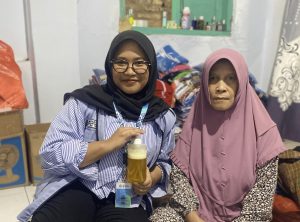
Kebondalem Village, Pemalang Regency — In order to raise public awareness about the importance of cleanliness and health, KKN-T Team 163 students from Diponegoro University held socialization and training on making natural hand sanitizer based on lemongrass extract. This activity was carried out together with the mothers of the Family Empowerment and Welfare Association (PKK) of RT 04 RW 03, Kebondalem Village, Pemalang Regency, on Thursday, August 7, 2025, at Ibu Mulyati’s house. The event was attended by residents who were enthusiastic to hear the presentation on the benefits of lemongrass.
This program was initiated by Neza Nur Rahayu, a student majoring in Industrial Chemical Engineering Technology, Faculty of Vocational Schools, with field supervisor Sri Risdhiyanti Nuswantari, S.Tr.T., M.T., and academic support from Dr. Ir. Fahmi Arifan, S.T., M.Eng., M.M., IPM., ASEAN Eng. Lemongrass was chosen as the main ingredient because it contains citral and geraniol compounds, which have been proven to have antibacterial activity and provide a fresh aroma. Additionally, utilizing lemongrass is also an effort to reduce the use of synthetic chemicals in hand cleaning products, making them safer for the skin and supporting the concept of environmental sustainability.
The formulation stage of lemongrass extract-based hand sanitizer is done in a simple yet beneficial way. The process begins by thoroughly washing five stalks of fresh lemongrass, then chopping them into small pieces to make it easier to extract the active compounds within. The lemongrass pieces were boiled in one liter of water for 30–45 minutes, until the characteristic fragrant steam of lemongrass emerged as a sign that the natural antibacterial essential oil had been released. After that, the boiled water is filtered to separate the dregs, then cooled until it’s ready to use. The clear, fresh-smelling liquid from the boiled mixture was then packaged into hygienic spray bottles, making it a safe, practical, and environmentally friendly natural hand sanitizer.
This socialization activity provides valuable experience for the PKK mothers of RT 04 RW 03. They realized that lemongrass, which was previously only known as a kitchen herb, could actually be processed into beneficial health products. With a simple and easy-to-practice method, the community now has a natural antiseptic alternative without additional chemicals. More than just keeping hands clean, this innovation is expected to open up home-based business opportunities using locally sourced materials that are economically valuable, while also supporting the healthy and environmentally friendly living movement.