
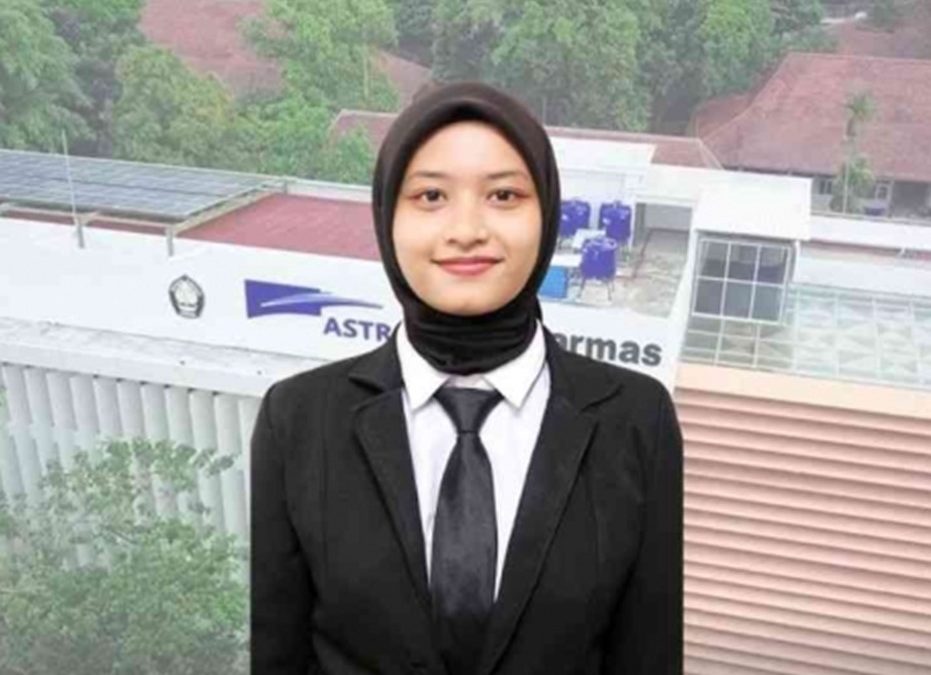
The perseverance and high fighting spirit of the students turned out to achieve extraordinary accomplishments, and the innovations they produced could become solutions to the problems faced by society. As demonstrated by Hanif Wening Nissa Aulia, a student from the Diploma Program in Industrial Chemical Engineering Technology (TRKI) at Undip. This student from the 2020 cohort, commonly known as Wening, successfully completed her TRKI applied bachelor’s degree on time, earning 6 patents and 4 intellectual property rights (HKI). Wening stated that thanks to the patience and guidance of her supervising lecturers, such as Dr. Eng. Vita Paramita, S.T, MM. M.Eng, and Mohamad Endy Julianto, she was finally able to achieve 4 HKI and 6 patents. The HKI includes: no. EC002023126219 (Spicy, Savory, and Addictive Snacks – Maqaroni Seblak MS Premium), no. EC002023126217 (RISAYO Healthy Snacks – Vegetable Mayo Risol, Delicious and Nutritious), no. EC00202347568 (Distillation 2), and no. EC00202371752 (Pervaporation Scheme 2). Simple patents that have been registered under the invention title “Enzymatic Extraction Process of Bay Leaf Phytochemical Compounds Using Immobilized Rumen Isolate” (Patent no S00202309590), “Natural Air Freshener Gel Formula with Bergamot and Ylang-Ylang Aroma Based on Carrageenan and Glucomannan” (Patent no S00202403234), “Hair Mask Formula from Sunflower Seed Oil (Helianthus annuus)” (Patent no S00202403230), “Preparation Method of Vanillin-Modified Chitosan Hydrogel Adsorbent” (Patent no S00202403233), “Co-precipitation Method of Magnetite Biosorbent Modified with Papaya Seeds (Carica Papaya L.)” (Patent no S00202403247), and “Natural Serum Gel Formula from Binahong Leaves (Anredera cordifolia)” (Patent no S00202403234), Wening explained.
Wening, who holds 16 certificates such as ISO 9001; ISO 14001; ISO 45001 Awareness, ISO 9001; ISO 14001; ISO 45001 Internal Auditor, Job Safety Analysis (JSA Domestic demand for soda ash is very high and will continue to increase, as evidenced by the import of soda ash, which reaches 800,000 tons per year. This is because there is no soda ash factory in the country yet. Therefore, a soda ash plant with a capacity of 150,000 tons per year is planned to meet domestic soda ash needs. The NaOH raw material comes from PT. Asahimas Chemical and the CO2 gas from PT. Samator Gas Cilegon. This factory will be established in the Cilegon Industrial Estate area, Banten, Wening explained.
Wening revealed that the production process for the soda ash plant using carbonation is due to its low operating conditions and the byproduct produced is water, resulting in a lower environmental impact. The reaction in this soda ash production process is exothermic and occurs in the absorber under operating conditions of 70 °C and 1 atm pressure. The bottom product from the absorber is a solution of Na2CO3 and water, which will then be evaporated and crystallized in the evaporator crystallizer. The formed crystal soda ash will be separated from its mother liquor using a centrifuge. The crystal soda ash will be dried in a rotary dryer at a size of 100 mesh using a ball mill and vibrating screen, and then the crystal soda ash will be stored in product storage. The process support unit consists of the water supply and treatment unit, the compressed air supply unit, and the steam and electricity supply unit. Additionally, it is equipped with a wastewater treatment unit, water and air pollution control units, and an analysis laboratory, Wening said.
Wening also added that the company structure of this factory is a Limited Liability Company (PT), with a total of 312 employes, including 233 process employes, operating the factory 24 hours a day for 330 days a year. The employe work system is based on division according to working hours, consisting of shift employes and non-shift employes. The economic analysis results show that this soda ash plant requires a fixed capital investment of USD 55,601,613.51 and a working capital investment of USD 33,315,804.92. This soda ash plant achieved a pre-tax and post-tax profit on sales (POS) of 34.07% and 15.28%, respectively. The pre-tax and post-tax return on investment (ROI) was 34.07% and 25.55%, respectively. The break-even point (BEP) and sales deviation point (SDP) were 48.16% and 29.90%, respectively. The internal rate of return (IRR) was 13.89%. Based on this economic analysis, the soda ash plant with a capacity of 150,000 tons/year is feasible to establish and has good business prospects, concluded Wening.