
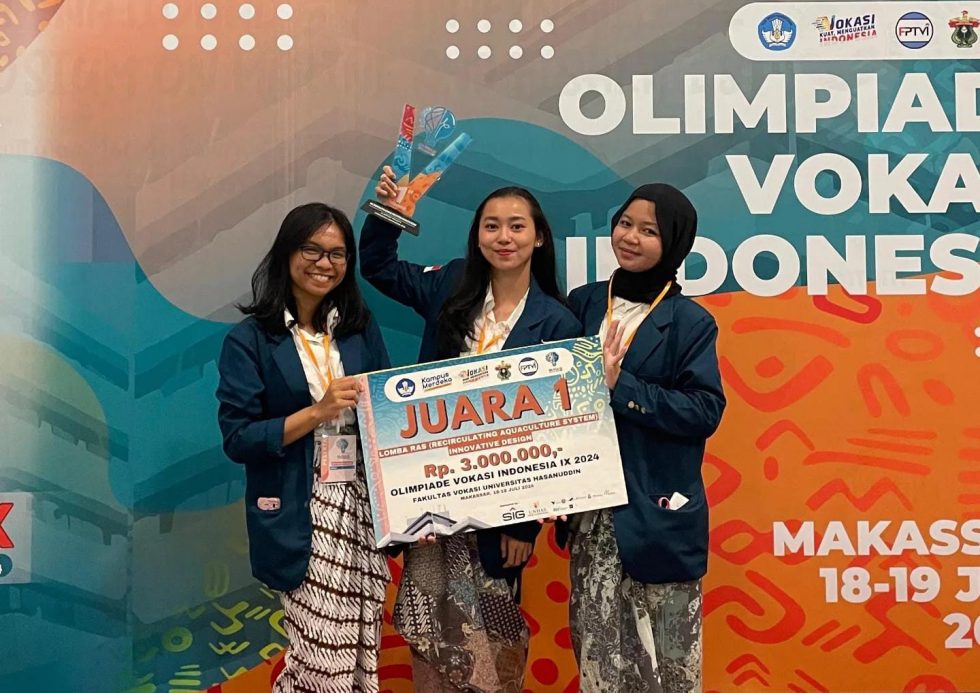
Another outstanding achievement was made by students from the Industrial Chemical Engineering Technology (TRKI) Study Program at the UNDIP Vocational School, who won 1st place in the 9th Indonesian Vocational Olympiad (OliVIa) 2024 competition held at the UNHAS Hotel & Convention on July 18-19, 2024. The competition, organized by the Indonesian Vocational Higher Education Forum and hosted by Hasanuddin University in Makassar, is a RAS (Recirculating Aquaculture System) competition. This prestigious event was attended by the post-millennial innovator team from the TRKI SV UNDIP student body, who were part of the Grafena Iridium team, including Tiurma Fransiska Simanullang as the team leader along with her two colleagues, Jeni Laura Tesalonika and Putri Sekar Kinanti. They have developed the digitalization of fish farming using smartphones.
Mohamad Endy Yulianto, S.T., M.T., as the Head of the TRKI Study Program at SV UNDIP, expressed his gratitude and pride in the achievements of the Grafena Iridium team, which successfully won the national championship. Endy, who is also involved as a supervising lecturer, admits to having contributed to guiding and playing an important role in providing ongoing support for the Graphene Iridium team. Thus, intensive discussion can help in the development and refinement of innovations in RAS design. Meanwhile, Dr. Ir. Agustina Abdullah S.Pt., M.Si., IPM, ASEAN Eng, as the Chair of the OliVIa IX 2024 Committee, stated that the OliVIa IX 2024 event featured 6 types of competitions with 23 sub-categories, involving 70 universities and 1,068 teams consisting of 3,204 students from all over Indonesia. Of that number, 407 students from 144 teams representing 32 universities successfully advanced to the final round. With the theme “Inspiring the Future thru Empowering Innovative Human Resources and Digital-Based Entrepreneurship,” OliVIa IX 2024 highlights issues related to technological innovation and entrepreneurship. This series of competitions began in March, with the first round of selections taking place in June 2024. By the end of June, the top 5 teams in the RAS competition were chosen. This was followed by the Grand Final and Awarding ceremony, which concluded the OliVIa IX 2024 event series.
Development of PVDF and CNT membranes as fish pond water filters. Complete with an ammonia sensor digitized by a smartphone and using solar panels as an alternative energy backup, this makes the aquaculture recirculation system innovation promising, environmentally friendly, and sustainable. “Water quality parameters that are very important and are aspects of the aquaculture ecosystem, namely the presence of ammonia levels. Ammonia that accumulates in the aquatic system must be removed because if it builds up, it can cause many fish to die. “The presence of digitalized ammonia sensors will make it easier for fish farmers to monitor healthy water quality,” said Tiurma.
Furthermore, Jeni explained that one of the distinguishing advantages of this project is its use of a conventional pool design with innovative layout and water circulation, as well as the use of solar panels as an alternative energy source to power pumps, nano aerators, UV filters, and sensors connected to smartphones. “By considering sustainability and environmental aspects, we will reduce dependence on conventional energy sources to realize the Indonesian government’s mission of achieving Indonesia’s Carbon Zero Emissions by 2060.” This was conveyed directly by the Coordinating Minister for Maritime Affairs and Investment in 2022 during the G20 event in Bali,” explained Jeni. Putri presented the design of the fish pond developed at a 1:100 scale, integrating ammonia sensors with valve openings. “The input is that if the ammonia level is less than 0.2 ppm, the valve leading to the polyammonia membrane will be opened wider. However, if the ammonia level exceeds 0.7 ppm, the sensor will send a signal to the valve to be narrowed. Therefore, the flow rate decreases and the residence time is longer inside the polymonia membrane, resulting in improved fish quality,” she explained. “Excessive ammonia levels in the water can inhibit fish growth, damage tissues, and even cause death. Therefore, the digitalization of this innovative Polimonia technology, which has been developed, can be applied to fish farming in the wider community in the future. Thru technology and innovative collaboration, it turns out that solutions can be produced that will have a positive impact in the future,” Putri concluded.