
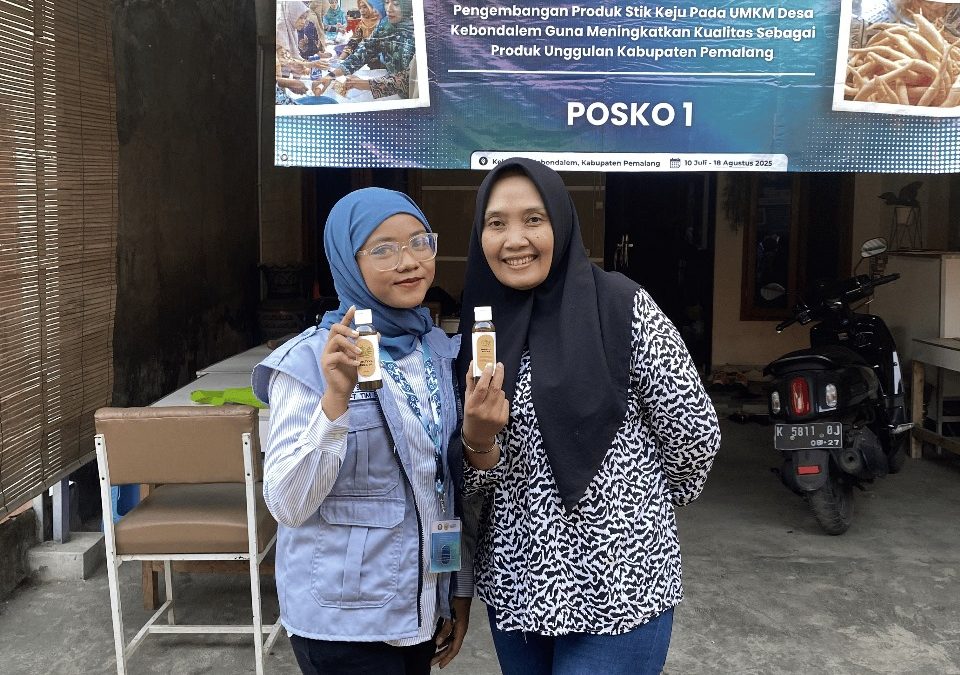
Kebondalem, Pemalang – As part of the Thematic Community Service Program (KKN) Team 163 of Diponegoro University, student Amelia Syahrani from the Department of Industrial Chemical Engineering Technology successfully implemented green technology on a small and medium-sized industrial scale within a multidisciplinary work program focused on optimizing the maintenance of cooking equipment for local SME actors. The work program carried out on Thursday, July 31, 2025, titled “Optimization of Cookware Maintenance Based on Anti-Rust and Non-Stick Cleaning Formulations,” is an initiative originating from a proposal by the KKN Field Supervisor Lecturer, Sri Risdhiyanti Nuswantari, S. Tr. T., M. T. She observed the problems of production equipment maintenance in food MSMEs, particularly the accumulation of fat residue and the formation of corrosion on metal surfaces, which can reduce production efficiency and product quality. She also saw the potential for developing practical solutions for micro-business owners.
The main target of this program is the Cheese Stick MSMEs located in Kebondalem Village, Pemalang District, Pemalang Regency, with the main partner being Mrs. Maharani, the business owner. Thru a simple yet effective technological approach, Amelia developed a natural cleaning formulation consisting of baking soda, moringa leaf powder, neem leaf powder, and vinegar. According to Amelia, the selection of these ingredients is based on their function in the cleaning liquid’s mechanism of action during use. Sodium bicarbonate (NaHCO₃) was chosen as the main component due to its amphoteric properties, which allow for regulating the system’s pH within the range of 8.1-8.4, the optimal condition for the cleaning process without causing excessive corrosion on the metal substrate. The kinetics of the reaction with acetic acid produces CO₂, which acts as a lifting agent for contaminant particles. Moringa oleifera leaf extract contains the bioactive compound quercetin (C₁₅H₁₀O₇) with an acid dissociation constant (pKa) of 6.31, which allows for optimal antioxidant activity at the system’s pH. The mechanism of oxidation inhibition occurs thru electron donation to free radicals, preventing the propagation of oxidation reactions on the metal surface. Neem leaves (Azadirachta indica) contribute thru the compound azadirachtin, which has a limonoid structure with an epoxide group that is reactive to microbial enzymes, resulting in a biocidal effect with a low minimum inhibitory concentration (MIC). D-limonene in lemon oil exhibits hydrophobic properties with a log P value of 4.83, enabling effective penetration into the lipid and triglyceride layers accumulated on the surface of cookware. The degreasing mechanism occurs thru the solubilization of fat based on the principle of “like dissolves like.”
This innovative cleaning liquid product is specifically designed to address the rust and stickiness issues frequently faced by MSME entrepreneurs, while also offering an environmentally friendly and economical cleaning alternative. This work program validates the concept of appropriate technology that integrates chemical engineering principles with environmental sustainability, while also providing practical solutions to small-scale industrial problems. This approach aligns with the Industry 4.0 paradigm, which emphasizes process efficiency and minimizing environmental impact thru the utilization of renewable raw materials. The implementation of this program is expected to improve operational efficiency and product quality for partner MSMEs, as well as make a real contribution to local economic development in Pemalang Regency.
This Thematic KKN program demonstrates Diponegoro University’s commitment to applying knowledge to provide direct benefits to the community, particularly in supporting the development of MSMEs as the backbone of the local economy.