
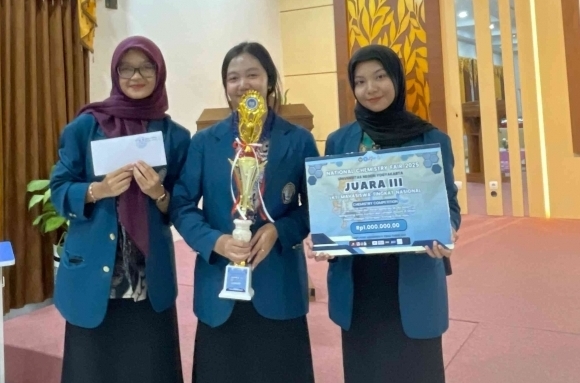
Students from the Industrial Chemical Engineering Technology (TRKI) study program at the Vocational School of Diponegoro University (SV Undip) have once again achieved a proud accomplishment at the national level. They successfully achieved 3rd place in the National Scientific Writing Competition organized by the Faculty of Mathematics and Natural Sciences at Yogyakarta State University (UNY).
This team introduced an innovation called Algae Plast: An Integrated Microalgae Bioreactor System and Pyrolysis Technology Innovation for Transforming Plastic Waste and CO2 into Sustainable Energy. This team of three talented students, led by Eryka Destiawanti as the chairperson and supported by Nur Ilma Awliya and Shervaya Latiffa as members, successfully developed an innovative solution for managing plastic waste and carbon emissions.
Under the guidance of lecturer Teguh Riyanto, S.T., M.T., this team successfully designed and developed a system that optimally integrates Direct Air Capture (DAC) technology, microalgae bioreactors, and pyrolysis. Support from their mentors was a crucial factor in refining this concept to the point where it could compete nationally and achieve impressive results.
In this competition, teams developed a system that combines DAC technology, microalgae bioreactors, and pyrolysis reactors to offer an innovative solution to the problem of plastic waste and carbon dioxide (CO2) emissions. This technology enables the conversion of plastic waste and atmospheric CO2 into pyrolysis oil, microalgae biomass, and char (carbon) that can be utilized as renewable energy.
The AlgaePlast process begins with the use of Direct Air Capture (DAC) technology to capture carbon dioxide (CO2) from the air. The absorbed CO2 is then used by the microalgae Spirulina sp in a bioreactor for photosynthesis, producing oxygen that increases combustion efficiency in the pyrolysis reactor. In the pyrolysis process, polypropylene (PP) plastic waste is broken down into pyrolysis oil, hydrogen gas (H), and short-chain hydrocarbons. “The H gas and hydrocarbons are then fed to the pyrolysis combustion unit to improve combustion efficiency, while the pyrolysis oil is used as an alternative fuel. Microalgae biomass can also be processed into health supplements and skincare products. “This AlgaePlast concept not only reduces carbon emissions but also provides a real solution for plastic waste management and produces high-value economic products,” explained one of the team members.
One of the interesting things about the team’s presentation is the interactive and engaging delivery, with humor that remains serious. This approach successfully captivated the attention of the judges and audience, positioning AlgaePlast as an innovation that is not only visionary but also easily understood by a wide range of people.
With this achievement, the team hopes that the AlgaePlast innovation can continue to be developed and gain attention from various parties, including industry and government, to support the implementation of sustainable environmentally friendly technology.
Meanwhile, the Head of the TRKI Study Program at the Vocational School of Diponegoro University, Endy Julianto, stated that this success proves that Indonesian youth have great potential in creating innovations that will bring change to the environment and the future of energy. “Hopefully, this achievement can be an inspiration for other young generations to continue working and contributing to the country,” he said.