
Cassava (Manihot esculenta crantz), also known as tapioca, is a tropical and subtropical perennial tree from the Euphorbiaceae family. Indonesia is the world’s 3rd largest producer of cassava after Brazil and Thailand, with a planting area of 1,119,784 hectares and an annual production of 23,922,075 tons of cassava. The potential for developing cassava plants in Indonesia is very promising. Nevertheless, its use is still limited to being a raw material for making tapioca flour and bioethanol, while efforts to utilize other parts such as the leaves, stems, or skin of the cassava plant have not yet been developed.
Mohamad Endy Yulianto, a lecturer in the Industrial Chemical Engineering Technology (TRKI) study program at Undip Vocational School, stated that cassava is a plant containing cyanogen compounds. Cyanogen compounds in cassava plants are in the form of cyanogen glycosides, consisting of linamarin (2–D-glucopyranosyloxy-2-methylpropanenitrile) and lotaustralin ((2R)-2–D-glucopyranosyloxy-2-methylbutyronitrile). Linamarin is a derivative of valine, while lotaustralin is a derivative of isoleucine. The ratio of linamarin to lotaustralin in cassava leaves and tubers is approximately 93:7. Cyanogenic glycoside compounds in cassava plants are mostly accumulated in the leaves, stems, and peel of the tubers, according to Endy. He also added that different cassava varieties show variations in linamarin content, ranging from 25-450 ug cyanide equivalent/g. This is believed to be due to differences in the rates of biosynthesis, degradation, and transport, as well as differences in environmental conditions and cassava cultivation methods.
Cyanogenic glycosides, in the presence of the enzyme linamarase (glucosidase), will hydrolyze into cyanohydrin. Subsequently, cyanohydrin will decompose into hydrogen cyanide. It is suspected that this mechanism is used by cassava plants and some other plants such as sorghum, almonds, and lima beans to repel predators, considering that hydrogen cyanide is a toxic compound for living organisms, explained Endy. Hydrogen cyanide can reduce energy availability in all cells, and its effects will be felt especially in the respiratory and cardiovascular systems. In some cases, consuming cassava with a relatively high cyanide content can cause poisoning and even death, said Endy.
Endy revealed that the process of linamarin hydrolysis by the enzyme linamarase primarily occurs due to mechanical processes (raw material preparation) or microbial activity (fermentation). The hydrolysis of linamarin consists of two reaction steps involving the formation of an intermediate compound, acetonecyanohydrin, which then spontaneously or by the action of the enzyme hydroxynitrilelyase forms acetone and hydrogen cyanide. Linamarin has properties that could make it a good candidate as an antineoplastic (anticancer) compound. Linamarin is also known as a nitriloside, which contains vitamin B17 that is expected to produce the cytotoxic compound HCN during hydrolysis. Neoplastic cells (cancer cells) that lack detoxification enzymes (rhodenase) but are rich in hydrolase enzymes will be exposed to the lethal effects of cyanide released by linamarin, Endy explained.
Considering the abundant availability of raw materials and the potential of linamarin as an antineoplastic compound, it is necessary to develop a process for producing linamarin from cassava leaves. However, there is currently no effective method for recovering linamarin from cassava plants. The difficulty experienced in the linamarin production process is during the extraction process. When the tissue is damaged, the linamarin will immediately hydrolyze into its individual components, namely acetocyanohydrin and glucose. This hydrolysis process is believed to be catalyzed by an enzyme found in the plant itself, namely linamarase,
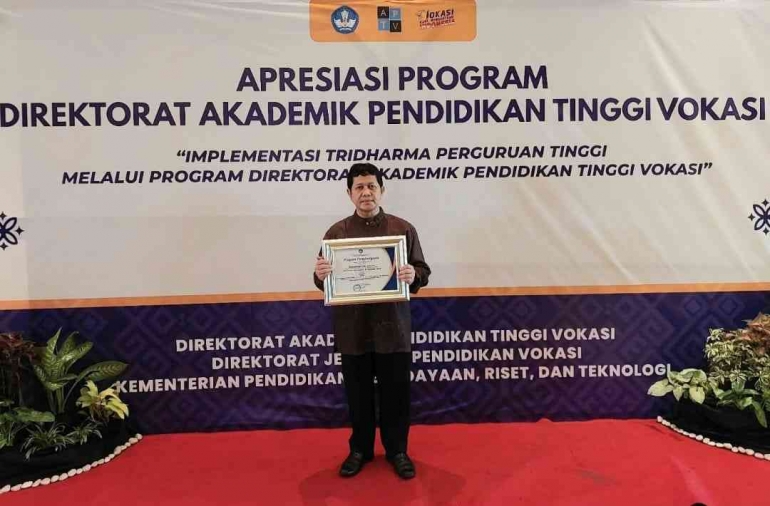
Endy explained. Endy stated that thru his Granted Patent no. IDS000006687 with the invention “Process for Extracting Linamarin from Cassava Leaves using an Enzymatic Inactivation Extractor,” it is very promising for commercialization. Hopefully, in the near future, we can commercialize Standardized Herbal Medicines (OHT) from cassava leaves, so that the results of this research can benefit the community, especially those who are fighting to recover from cancer, concluded Endy.